installation
Audiovisual installation utilising acoustic remote sensing for seabed mapping
side-scan sonar plexiglass prints in lightboxes, multi-beam echosounder digital video, inkjet prints, custom-made wooden bathymetric map, 5.1 sound system

Side-scan sonar of a shipwreck at Elefsina Bay
Covering more than seven-tenths of the Earth, the uninviting sea signifies a threshold, a vast and enigmatic realm. Within ancient cosmologies, the sea has been sacralised by many cultures and often represented as a purifying vessel of human activity, with the power to cleanse what is dangerous, dirty, and morally contaminating. Likewise, its depths, the undersea has been thought of as a no man’s land, an inaccessible and uninhabitable terra incognita. We still claim that we know more about the surface of the moon than what the oceanic seabed conceals. Indeed, the bottom of the sea is both a hiding place and a convenient rug under which humanity has been sweeping anything non-wanted.
Once ships are sunk, they are removed from ship registries and are therefore deleted from the present. However, their ghostly material remains tend to stay with us for much longer, representing the third in rank source of oceanic pollution alongside acidification and microplastics. The leading global heritage organization, UNESCO, protects wrecks that have sunk before 100 years ago, therefore recently wrecked ships are currently in a limbo state, depending on governments and regional policies towards their removal and safe decommissioning. Sounding the Silent World is an archaeological/environmental artistic research project focusing on the latent state at the end of a vessel’s life cycle, when a ship becomes a phantom entity wavering between marine debris and monumental status, while on the other hand it aesthetically explores notions of the romantic sublime, in a time of man-made catastrophes. The project views the seafloor as a cultural landscape, a dynamic archive, which complements terrestrial landscapes in mirroring our societal practices. With shipwrecks representing large-scale human time-capsules, as well as debris, there is a lot to be learnt about our present failures, through the exploration of their material, environmental, and metaphorical dimensions.
ΚΑΤō ΚΟΣΜΟΣ (meaning underworld in greek) is the first iteration and kick-off of the broader project, which will gradually expand into a diverse assemblage of artistic and theoretical outcomes across media and locales around the world. As a case study, It is centred around an atypical ship graveyard in the bay of Eleusis -an ancient Greek sanctuary and ritual centre and portal to the mythological underworld- where ruins of a “deeper” past intersperse with ruins of the present in a catastrophic cohabitation. The works exhibited resulted from an underwater exploratory drift in the bay of Eleusis, that bore the objective of mapping the shipwrecks and other mysterious objects it hosts through the employment of imaging methods used in maritime archaeology and oceanography. It consists of finds collected by an interdisciplinary team that investigated, organised, and executed an offshore survey by utilising acoustic remote sensing (side-scan sonar, multibeam echosounder, hydrophones), presenting thereby imagery created exclusively via sound. Unlike optical and electromagnetic waves, acoustic waves can travel long distances underwater, making them the primary tool for sensing and metaphorically listening to the ocean.
Eleusis knows how to craft mysteries and remain silent around them, all the while sustaining their enigmatic dimension through time. The new mysteries that this project salvaged from the sea are also subject to a different, contemporary code of silence concerning some hard-to-ignore toxic material realities. However, despite their persistence, no one seems to want to see or hear these realities. Under this light, the project’s major undertaking is to “listen” to the spectres of this watery underworld and channel their whispers to the surface, in order to expose them in plain sight with the hope that someone eventually will listen. In this light, the artist becomes an ‘archaeologist’ and proceeds to a symbolic rediscovery of these materialities in order to remind the visitor of their presence, but to also create an ambiguous, gold-coloured space of contemplation; not on success as the colour would suggest, but on our failures, whether these are sociopolitical, environmental or personal.
The exhibited works resulted from a seabed mapping survey conducted in May 2023 with the research vessel Antaris II.
Sounding the Silent World is the winner of the 2022 Prix COAL – Océans, Prize for Art and Ecology. Its research was supported by Onassis AiR. KATõ ΚΟΣΜΟΣ is a new work commission by 2023 Eleusis European Capital of Culture with the support of the National Museum of Contemporary Arts (EMST) Athens. It was first presented at the Old Olive Mill in Elefsina, Greece as part of the flagship art show Mystery 3 Elefsina Mon Amour: In Search of the Third Paradise curated by Katerina Gregos. The project is currently continuing its research in various locations in Brittany, France supported by the IN SITU programme at the Cité Internationale des Arts, funded by the Fondation Daniel et Nina Carasso.
Credits Maritime survey team: Dimitris Sakellariou, Ioannis Morfis (side-scan sonar/ Hellenic Center for Marine Research-HCMR), Kostas Bakalos (multibeam echosounder), Nikos Kokonakis (vessel captain) | Hydrophone field recordings & Sound design: Manolis Manousakis | Video Colorist: Sakis Bouzanis 2|35 | Research: Yannis-Orestis Papadimitriou, Marina Gioti | Scientific advisor: Aris Anagnostopoulos | Map Design, prints: Yorgos Kazakos Thanks Bénédicte Alliot and the team of Cité Internationale des Arts, María Inés Rodríguez, Jean-Christophe Lanquetin, Annabela Tournon, Fellows of the IN SITU programme, Fondation Daniel and Nina Carasso, Eva Vaslamatzi, Jacob Moe, Yiannis Hadjiaslanis, Despina Koutsoumba, Hellenic Centre for Marine Research (HCMR), Nefeli Myrodia (Onassis AiR), Lauranne Germond (COAL), Fondation François Sommer/ Musée de la Chasse et de la Nature, Geli Mademli, Orestis Andreadakis, Ash Bulayev, Dimitris Gkotsis, Mina Dreki, Dimitris Kalpakis, Georgios Papadopoulos, Giannis Kanakis, Stelios Apostolopoulos, Niko Dayandas.
Exhibitions
2026 | Deep Fields, Centre Wallonie-Bruxelles, Paris
2024 | KATō KOΣΜΟΣ, Galerie Dominique Fiat, Paris (solo)
2024 | COALITION – 15 Ans d’art et d’écologie, La Gaîté Lyrique, Paris
2023 | Mystery 3 Elefsina Mon Amour: In Search of the Third Paradise, flagship art exhibition of 2023 Eleusis European Cultural Capital, Old Olive Mill, Elefsina
Collections
Onassis Collection
Installation documentation photos
KATō KOΣΜΟΣ, Galerie Dominique Fiat, Paris


Elefsina Mon Amour exhibition, Old Olive Mill © Yiannis Hadjiaslanis


Installation video | multibeam echo sounder sonar (excerpt)
Video stills © Marina Gioti


Elefsina Bay seabed mapping survey photos © Marina Gioti


Mixed media Installation
Fax machine, thermal transfer paper, landline

An old fax machine, receiving messages from regions experiencing internet shutdowns, turns into an accidental aggregator of offline stories about digital deprivation unfolding on a roll of thermal paper.
The work was commissioned by Imagine You Wake Up and There is No Internet exhibition through a NEON Greece fund. The show was curated by K. Gkoutziouli & Voltnoi Brege and took place at Romantso, Athens in October 2020.
Installation shots © Thanassis Gatos
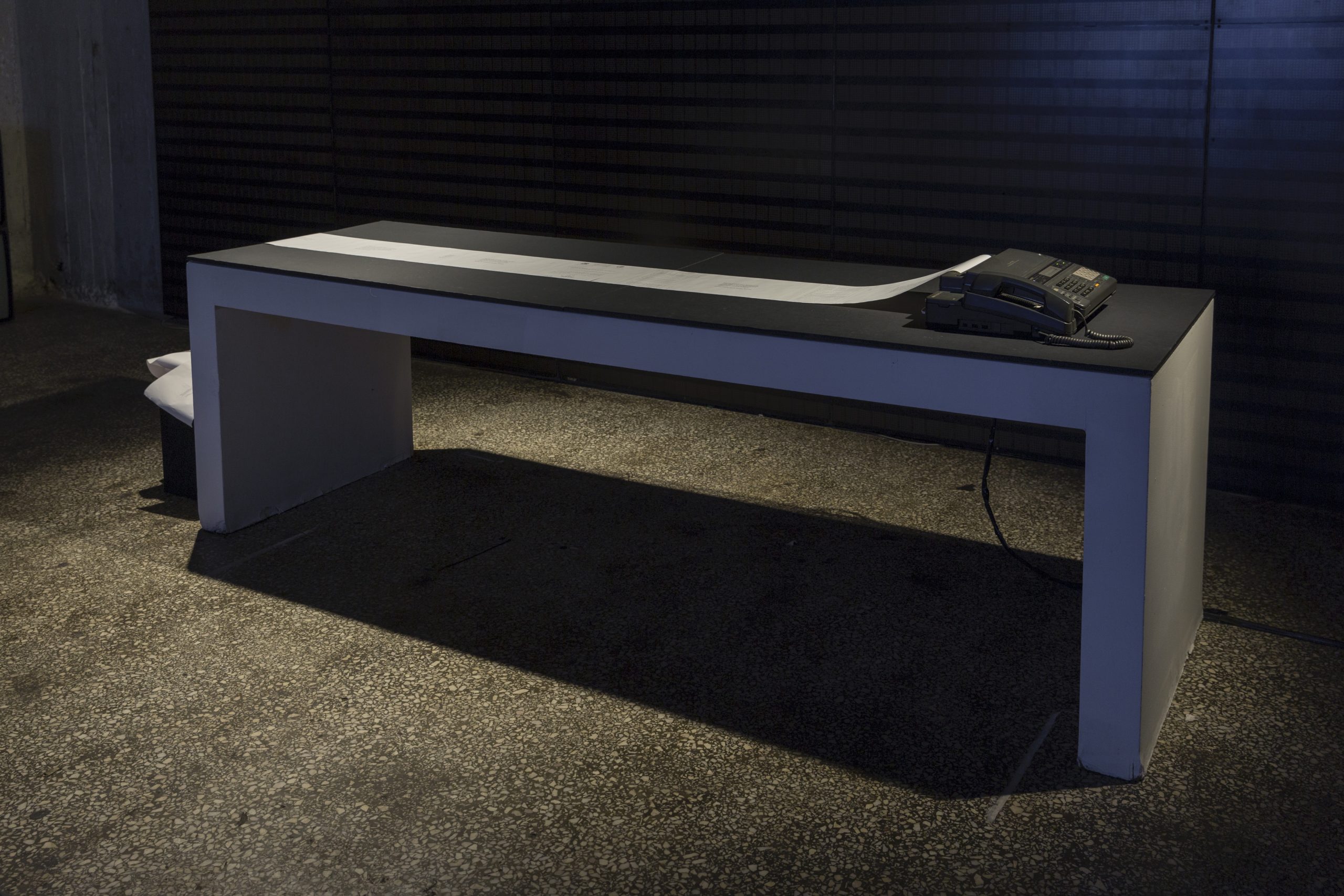


Installation, variable dimensions
35mm slides, video, archival originals, print reproductions on paper, backlit and canvas, slides viewer, book, mannequin

Installation view
During and after WWII, the industrial nations and the world saw a series of important changes in sciences and techno-scientific progress was seen as the driver of history. These so-called golden years of -largely military funded- scientific research where characterized by immediate implementation, limited corporate accountability, and the motto: “Science Finds, Industry Applies, Man Conforms”. Although largely secular and materialist, the history of technology has always been accompanied by myths of social transformation and transcendence to more democracy, peace, liberty, race and gender equality, free time and so on. History has it that some of these myths rarely materialized, but on the contrary, brought lasting negative impacts both on humans and the planet and on the other hand eventually recycled old power structures, superstitions and anxieties. These myths sink to oblivion when technologies are fully incorporated to our life, when they lose their phantasmagoria and enter banality, or even when they prove catastrophic.
Like an invented verb tense, Past Future Perfect revisits this particular era and ponders on the things that a promising future past delivered “not necessarily as-advertised”. In the work, the artist assumes the role of the curator of an idiosyncratic “museum” of technological history and material culture, consisting of an assemblage of found documents, souvenirs, ephemera, newsreels, and everyday memories, excavated from internet auction sites, online depositories and garbage dumps. By exposing these documents, the work aspires to loosely weave strands of known and less known stories from an era when the major technological myths were created, marketed and disseminated feeding the collective imaginary with hope and expectation. What followed is more or less known, besides spaceships, superhighways, benevolent robots and complex kitchen gadgets, we also got asbestos, DDT, plastics, CFCs and forever chemicals; the Exxon Valdez oil spill, Chernobyl and Bhopal. Without using any explicit visual reference to our present dystopias, the work delves into an industrial archaeology of the time that the future was all ours and something to dream about, which is not exactly the case in our time.
Chronologically -and symbolically- all these stories unfold between the two emblematic celebrations of the futuristic imaginary, the two New York World’s Fairs of 1939 and 1964. This timeframe, which is extending from the post Great depression years, through WWII and the Cold War, coincides with the period of The Great Acceleration in the Anthropocene discourse, where atmospheric, geologic, hydrologic, biospheric and other earth system processes were significantly altered by human influence and activity. Although the Cold War had two main opponents and several proxy actors, the focus is on the American corporate capitalist model and paradigm of scientific progress, that from mid 20th century to the present, defined post WWII western culture and evolved as the dominant one worldwide.
Past Future Perfect was commissioned by Akademie Schloss Solitude, Stuttgart and was the result of a three month residency (2017) in co-operation with Kunsthalle Athena. It was first presented as a solo show at the Akademie from 20/9/2018 to 7/12/2018, as part of the program “Postcards of a human landscape”.
Link to full documentation
Documentation Photos
(credits: Frank Kleinbach, Marina Gioti)

Installation view 1

Installation view 2

Installation View 3

Installation view 4

Installation view 5

Installation view 6

“A Hand in Things to Come” exhibit. Backlit print reproductions from Union Carbide print ads, ca. 1952-1965

“Operation Doom-Town” exhibit. Print reproduction from Nevada Highways and Parks Magazine (ca.1953), male mannequin

“A Fable for Tomorrow” exhibit. Rachel Carson “Silent Spring” book, Chapter 1

“New Lands” exhibit. Canvas print, wood. Reproduction from Fortune magazine (Oct. 1940) article

“Ruins In Reverse” exhibit, detail. Tokai Nuclear Plant, Japan construction diary (ca.1964). 35mm slides on Logan slide viewer

“There was once a town in the heart of America” exhibit, detail. Found family archive (ca. 1950-1970) on 35mm slides. Timed slide-show on Kodak Carousel

“The World of the Future” exhibit. Books, postcards, brochures and print reproductions

“The World of the Future” exhibit, detail 1. Books, map, tickets

“The World of the Future” exhibit, detail 2. Book, postcards, print reproductions

“Persuasion” exhibit, detail. Ads ca. 1945-1965, print reproductions Ads ca. 1945-1965, print reproductions
Installation utilising sleep study lab data
Plants, kinetic sculpture, LED lights, automations, sound, 6hrs 30mins

Artist’s Note: On The Opacity of Sleep
“Overlooking the gardens, the differences between habitual rhythms blur; they seem to disappear into a sculptural immobility…. But look at those trees, those lawns and those groves. To your eyes they situate themselves in a permanence, in a spatial simultaneity, in a coexistence. But look harder and longer. This simultaneity, up to a certain point, is only apparent: a surface, a spectacle. Go deeper, listen attentively instead of simply looking, of reflecting the effects of a mirror. You thus perceive that each plant, each tree, has its rhythm, made up of several: the trees, the flowers, the seeds and fruits, each have their time. Continue and you will see this garden and the objects (which are in no way things) polyrhythmically, or if you prefer symphonically. In place of a collection of fixed things, you will follow each being, each body, as having its own time above the whole. Each one therefore having its place, its rhythm, with its recent past, a foreseeable and a distant future.”
Henri Lefebvre, “Rhythmanalysis: Space, Time and Everyday Life”
Even at the seemingly idle state of sleep, our body is a symphony of oscillations, a polyrhythmia, where each organ pulsates in its own way producing valuable work for cell renewal, memory, learning and decision-making. Polysomnography or Sleep Study, is a medical method that identifies and evaluates multiple variables of the human body during sleep and helps prevent and cure diseases and disorders. By studying each body organ separately, it registers its rhythm; the repetitive motifs of our organs, which despite their idle pace, work ceaselessly during these 8 hours that we daily lose our consciousness. If one rhythm deregulates, there is a suspicion of disease.
Polysomnogarden borrows data from the lab, in order to create an environment that is transformed according to the stages of sleep. That is the actual sleep of the artist, who while unconscious has volunteered to the production of the long, unedited and mundane “narrative” called “one night’s sleep”. The method used essentially interprets the signals of bodily organs, notably brain waves, eye movement, heart rate, breathing, and the position of the body among others, into sound, light and kinesis, within a paradoxical interior garden, cut-off from the outside world. With the ‘participating’ plants possessing their own individual rhythms -despite their “sculptural immobility”-, the rhythms multiply and polyrhythmia reverberates inside the garden/ artwork.
Although science is the powerhouse behind the work, it’s at the same time rendered deliberately invisible, allowing more space for sensory perception to prevail. In this fictional landscape of interiority, the visitor is invited to observe and experience sleep as a rhythmic phenomenon and at the same time as an uncanny one, as a mystery, which the work does not wish to solve. As a medical method of ‘surveillance’, polysomnography, is able to effectively map and measure a sleeping body, yet, for better or for worse, it cannot pry into the unconscious mind. Sleep resists. Sleep is opaque. It’s firmly shut, as if nature itself foresaw a daily refuge of privacy, perhaps one of the last available today.
CREDITS
Sound Programming and Design: Coti K
Programming, Automations: Thanos Eleftherakos
Light Design: Tasos Paleoroutas
Architectural Supervision: Yannis Arvanitis
Garden Construction Advice: Olga Manetta
Sleep Science Advisor: Hara Tsekou
Commission and Touring support: Onassis Cultural Centre, Athens, Greece
In collaboration with the Sleep Study Clinic of Evangelismos hospital, Athens
THANKS
Christina Liata, Pasqua Vorgia, Konstantina Soulioti (OCC)
Prof. M. Vayiakis, Thanos Kallimanis (Sleep Study Lab of Evangelismos Hospital, Athens)
Odysseas Tsolkas, Dimitris Filopoulos
In loving memory of Hara Tsekou
Exhibitions
– Hypnos Project, Onassis Cultural Center, Athens, Greece, May 2016
– Donau Festival, Forum Frohner, Krems, Austria, 27-29 April 2018
Donau Festival, Museum Frohner Krems An der Donau – documentation video (April 2018)
Donau Festival Installation Shots (April 2018)
© Marina Gioti, David Višnjić/ Donau Festival


Installation
Color, silent, loop

Installation view, Akademie Schloss Solitude – Projectrraum Römerstrasse 2A, Stuttgart
Is washing the dishes a daily meditation and a way to get velvety hands? Does inhaling laundry products make women feel high? Can cleaning the windows make a woman reach nirvana? When is a window clean enough? “Ammoniasol” suggests that it’s an endless process as much as the elimination of gendered advertising we all grew up with.
Exhibitions
– I Synchroni Ellinida, The Hub Art Space, Athens, Greece (curated by Marina Fokidis)
– When a Wave Rolls Out and the Next Has Not Yet Broken, Akademie Schloss Solitude – Projektraum Römerstrasse 2A, Stuttgart, Germany
Installation
Modified turntable, vinyl, clay sculpture, screen
Mixed media installation featuring the Gramoscope, a ‘prepared’ turntable.
Installation documentation
The memory of a song enables the transformation of a turntable into a ouija board, where a discussion between Thomas Edison and Kurt Cobain takes place.
Exhibition
– Anathena, Deste Foundation, Athens, Greece